Around the world, democracy is under pressure. Concepts like ESG (Environmental, Social, and Governance) and DEI (Diversity, Equity, and Inclusion) are being debated in universities and corporate boardrooms alike. In this shifting landscape, institutions face a crucial choice:
Will they adapt their ways of working to navigate a more complex world, or continue relying on outdated models that ignore these changes?
At the same time, Artificial Intelligence is transforming how we think about work, value, and even what it means to be human. Businesses face practical questions: Should they invest in new software, or focus on training their people?
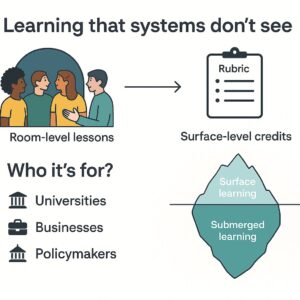
Programmes like Erasmus+① and EC2U② support international learning and mobility, yet there is still no global system that recognises learning beyond traditional classrooms, especially in the Global South. And this is often where the most valuable learning happens: in informal economies, through hands-on leadership experience, and by working directly with complex systems.
This is not the edge of education; it is the frontline of solutions to the world’s interconnected challenges.
Our organisation stands at the meeting point of these groups. We place outstanding interns into high-impact ESG projects across the Global South, lowering the cost of creating impact while building partnerships that help organisations turn complexity into coordinated action, much like an orchestra of different instruments coming together to create music.
① Erasmus+ is a programme funded by the European Union that supports education, training, youth, and sport across Europe and beyond.
② EC2U stands for European Campus of City-Universities. It is a European university alliance that fosters a shared, cross-border learning environment for students, researchers, and cities.
 |  |
Future learners inherit a system that perpetuates inequality rather than addressing it.
This process is closely linked to epistemic laundering. Originally coined by data scientist Cathy O’Neil to describe how algorithms hide bias under the guise of neutrality, we use it here to show how academic systems strip Southern knowledge of context and rebrand it as objective or Northern-derived, often after penalising students for engaging deeply with the environments from which the knowledge emerges.
A clear example: The San people of Southern Africa knew the hoodia plant suppressed appetite. Northern Labs patented and commercialised it, giving the San no credit.
 This same risk exists in student placements. When evaluation rubrics lag, contributions that benefit local communities go unrecognised, and universities miss vital lessons about how businesses exploit regulatory gaps, especially in the Global South.
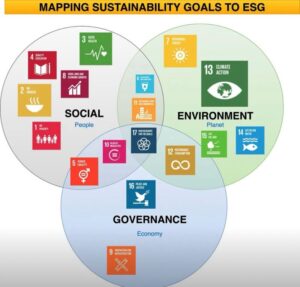
If universities acknowledged these neocolonial dynamics, they could align their practices, including endowment investments, more closely with the UN Sustainable Development Goals (SDGs).
Ready4Life’s approach:
The result: complexity becomes cooperation, context becomes opportunity, and knowledge becomes immediate ESG impact.